Physiokinetotherapy and Rehabilitation
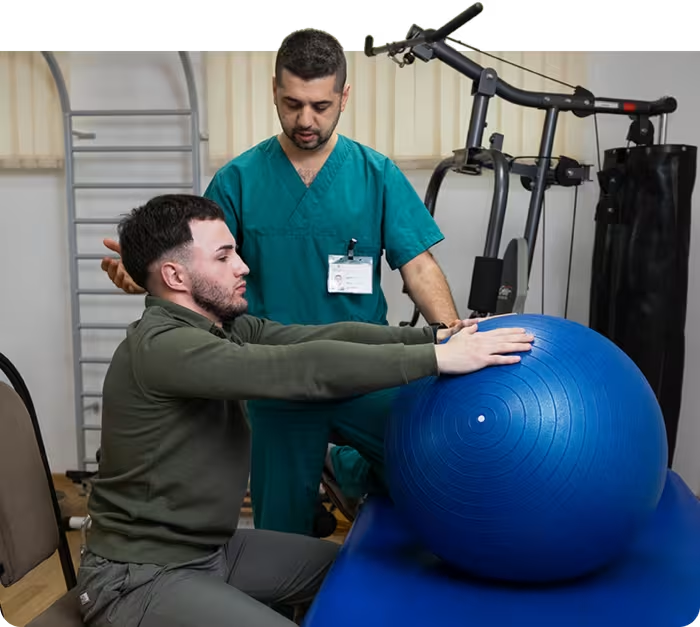
The mission of the Physiokinetotherapy and Rehabilitation study program is to provide educational and research services and to train qualified specialists for primary, hospital and community healthcare.
3 years, full-time
5500 €/academic year
English, Romanian
Required Documents
Nicolae Testemițanu State University of Medicine and Pharmacy of the Republic of Moldova accepts candidates for first-year admission and candidates for transfer from other universities. Send the documents to the address foreign@usmf.md.
Application form
Copy of the national identity document
- National passport
- Validity > 1 year from entry date on the territory of the Republic of Moldova
Copies of documents of education
- Translated into Romanian, English, or Russian
- Notarized and legalized
Copy of language proficiency certificate
- The language in which the applicant wishes to study
Copy of the birth certificate
- Notarized
Copy of parental consent
- For persons who have not reached the age of 18
- Notarized
- Sample of Parental consent
Copy of marriage certificate
Declaration of responsibility for veridity and legality of submitted documents
3 Photographs
- 1 digital passport / visa photo, 3 × 4 cm
- 2 matte passport / visa photos, 3 × 4 cm
Important
Documents mentioned in points 3, 4, 5, 6, and 7 must be translated into Romanian, English, or Russian, notarized and legalized in the manner established by the state authorities of the respective country.
Please send all documents as scanned copies with a minimum resolution of 300 dpi. Each document (including both sides and apostille/superlegalization where applicable) must be submitted in a separate file, named according to the following format:
Student_Name_Document_Name (Example: John_Smith_Passport.pdf, John_Smith_High_School_Diploma.pdf)
All documents should be sent in one single email to foreign@usmf.md. Any subsequent messages or additional documents must be sent as replies to the same email thread.
Application form for transfer
Copy of the national identity document
- National passport
- Validity > 1 year from entry date on the territory of the Republic of Moldova
Copies of documents of education
- Translated into Romanian, English, or Russian
- Notarized and legalized
Copy of language proficiency certificate
- The language in which the applicant wishes to study
Copy of the birth certificate
- Notarized
Copy of parental consent
- For persons who have not reached the age of 18
- Notarized
- Sample of Parental consent
Copy of marriage certificate
Declaration of responsibility for veridity and legality of submitted documents
3 Photographs
- 1 digital passport / visa photo, 3 × 4 cm
- 2 matte passport / visa photos, 3 × 4 cm
Academic transcript
- Issued by the previous university
Curriculum
- Issued by the previous university
Important
Documents mentioned in points 3, 4, 5, 6, 7, 10, and 11 must be translated into Romanian, English, or Russian, notarized and legalized in the manner established by the state authorities of the respective country.
Please send all documents as scanned copies with a minimum resolution of 300 dpi. Each document (including both sides and apostille/superlegalization where applicable) must be submitted in a separate file, named according to the following format:
Student_Name_Document_Name (Example: John_Smith_Passport.pdf, John_Smith_High_School_Diploma.pdf)
All documents should be sent in one single email to foreign@usmf.md. Any subsequent messages or additional documents must be sent as replies to the same email thread.